The process wasn't broken. It just didn't exist.
The Beyond Your WHY podcast had been running for 3–4 years. Every episode followed a process — but that process lived almost entirely in one team member's head. Bella handled production end-to-end: take the raw recording, send it to an external editing team, wait for the cut, upload to Acast, email the guest a link. That was it. No ClickUp task. No documentation. No distributed ownership.
When leadership decided to bring production in-house and hand off the admin side to Angel, the incoming EA, they realized there was nothing to hand off. The only documentation was a short note about when to send a Zoom link and how to schedule on Acast. Everything else was tribal knowledge — and tribal knowledge doesn't transfer.
My job was to turn four years of undocumented process into something a three-person team could run cleanly, consistently, and without anyone having to ask Bella what comes next.
- No task tracking
- External editing team, 2-week turnaround
- No guest email templates
- No file structure or shared assets
- Blog and social written from scratch
- No cross-promotion kit for guests
- 22-subtask ClickUp template, pre-assigned
- Riverside.fm, in-house editing, 2-day turnaround
- Full guest email template library
- Google Drive architecture with shared guest access
- ChatGPT project — blog, social, timestamps in minutes
- Cross-promotion kit ready on episode release
Seven systems that replaced four years of tribal knowledge.
With no documentation to start from, I interviewed Bella to reverse-engineer the existing process step by step. Then I rebuilt it from the ground up — not just the workflow, but every supporting system the workflow depends on.
-
01Platform Migration — Zoom → Riverside.fmRecommended migrating from Zoom to Riverside for higher audio and video quality, faster native clip creation, and better editing workflow for Bella. Riverside's native clip tool replaced a separate bottleneck step — Bella now creates promo video snippets directly inside the platform without a second export pass.
-
02Google Drive ArchitectureDesigned a standardized folder structure for every episode: episode root folder, subfolders for Raw Recordings, Edited Episode, Graphics, Cross Promotion Kit, and Guest Assets. All guest-facing folders use open-access shared links so guests can drop in headshots and bios without any back-and-forth. Assets are always findable, shareable, and organized the same way every time.
-
03ClickUp Task Template — 22 Pre-Assigned SubtasksBuilt a ClickUp task template that's duplicated for every new episode. All 22 subtasks are pre-assigned by team member — Angel handles guest communication and admin, Bella handles editing and graphics, I handle content. Each subtask has embedded instructions and direct links to everything that person needs to complete it. No one has to ask what they own or where to find anything.
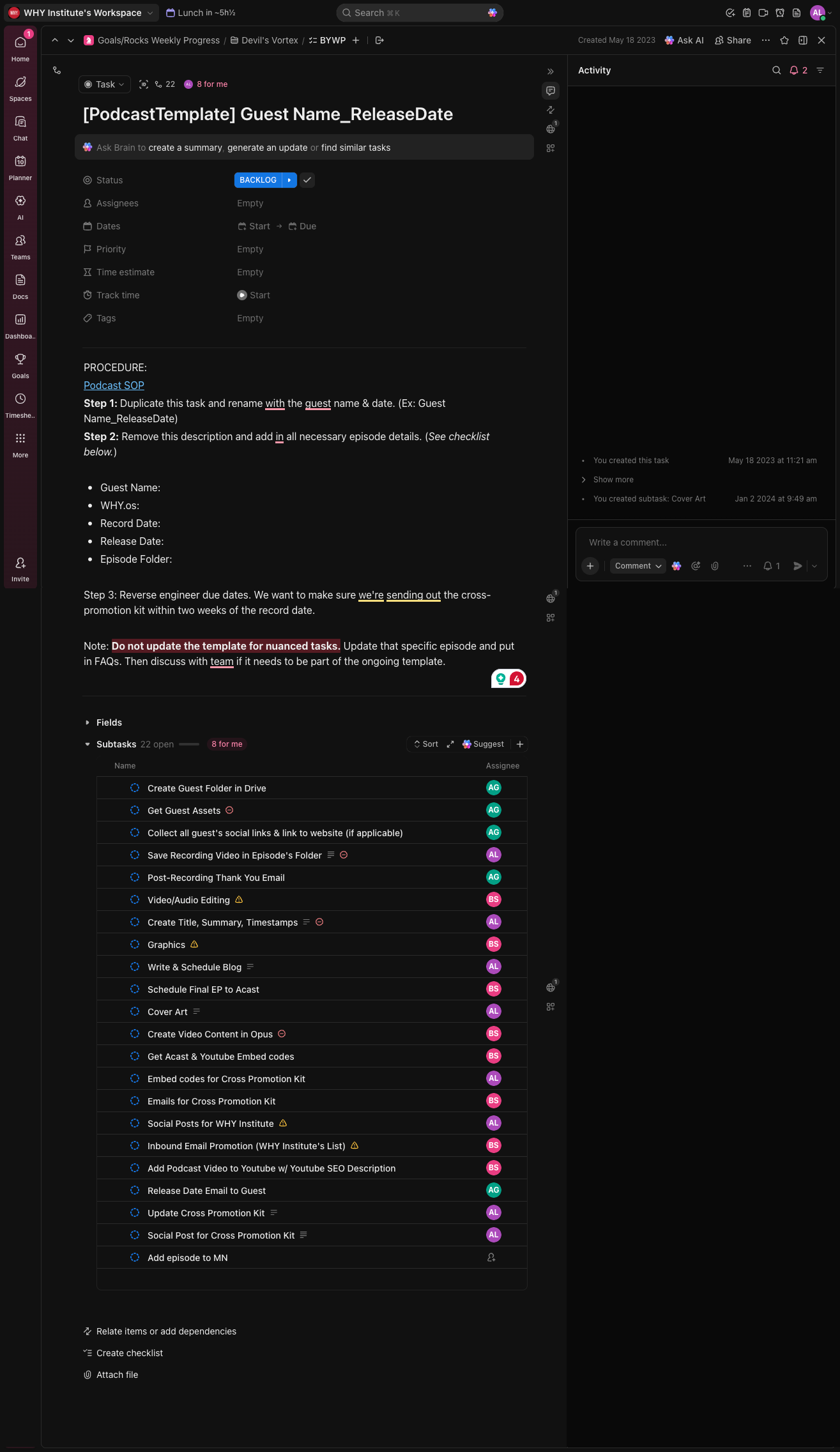
ClickUp episode task template — 22 subtasks pre-assigned by team member, each with embedded instructions and direct links
-
04Guest Communication TemplatesWrote the complete library of guest email templates: pre-recording confirmation, post-recording thank-you, episode release notification, and follow-up sequences. These live in Angel's hands now — she can handle all guest communication without Bella being in the loop at all. The templates are still in use today, unchanged.
-
05Cross-Promotion Kit SystemBuilt a templated cross-promotion kit that goes out to every guest after their episode releases. It includes social captions (pre-written for them), embed codes for the episode, graphics, and a direct link to the episode folder. Guests can start promoting immediately with zero back-and-forth. The kit is duplicated and customized per guest as part of the standard ClickUp workflow.
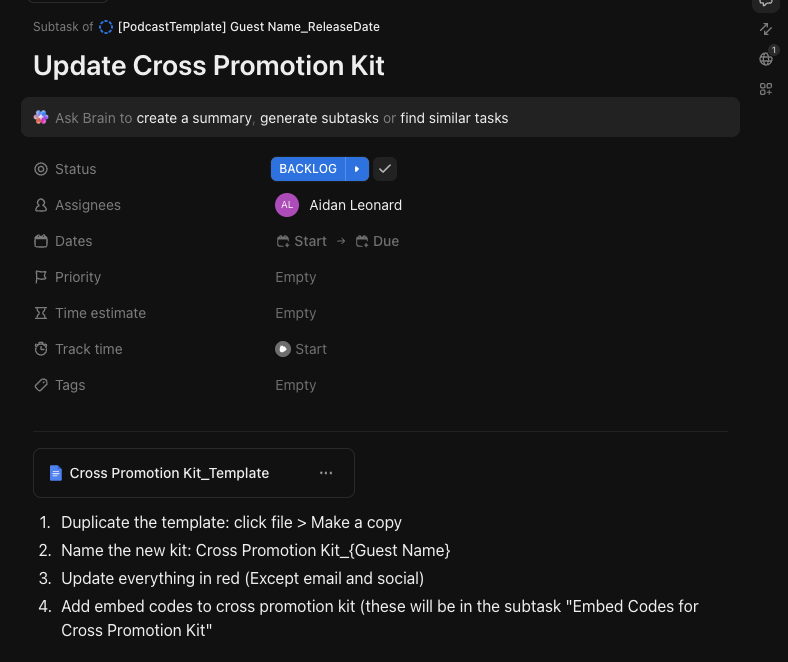
Cross-promotion kit subtask — embedded instructions and direct links so the kit ships with every episode, no coordination required
-
06ChatGPT Project — AI Content GenerationBuilt a custom ChatGPT project with a tailored prompt library trained on WHY Institute's voice and content style. The workflow: drop in the episode transcript, tell it the guest name, and it generates a full blog post, social captions for WHY Institute, social captions for the guest's cross-promotion kit, meta description, timestamp highlights, and title suggestions — in minutes. What used to take hours of writing time is now a review-and-post workflow.
-
07Ownership Distribution Across a 3-Person TeamThe final deliverable wasn't just a set of tools — it was a team structure. Angel owns guest communication and episode setup. Bella owns editing, graphics, and publishing. I own title creation, blog posts, and the cross-promotion kit. Every lane is documented, pre-assigned, and self-contained. No one is a dependency for someone else's work.
A 3–4 year undocumented process became a duplicatable system. It's still running today.
The system launched cleanly. No missed deadlines in the first quarter post-implementation — and no significant modifications since. The ClickUp template gets duplicated, the assignees pick up their subtasks, and the episode ships.
- Episode turnaround dropped from 2 weeks to 2 days
- $18,000 in annual production costs eliminated by removing the external editing team
- A 3–4 year undocumented process became a fully systematized, duplicatable workflow
- Zero missed publish deadlines post-implementation
- Guest experience improved — a ready-to-use promo kit made it effortless for guests to promote their episode
- Admin burden fully shifted off Bella and onto Angel, with no handoff friction
- AI-assisted content generation collapsed hours of writing into a minutes-long review workflow
- The system is still running today with no significant modifications
Process problems look like people problems until you map them.
Bella wasn't dropping balls — she was the entire system. The problem wasn't her performance. It was that everything lived in her head, and nothing was designed to run without her.
The fix wasn't motivational. It was structural. Give everyone clarity on what they own, the tools to execute it, and a system that doesn't depend on any one person's memory — and they'll deliver. Every time.
This is the work I find most satisfying: taking something invisible and making it scalable. Not because the original owner was failing, but because good systems shouldn't require a hero to function.
This win demonstrates systems architecture from a blank slate, cross-functional workflow design, AI tooling implementation, and the ability to take something invisible and turn it into something a team can actually run.