11,000 subscribers. No signal on what any of them actually wanted.
WHY Institute had over 11,000 contacts who had completed the WHY Assessment but never converted to WHY.os — the company's core paid product. The list had received only sporadic, ad hoc emails with no strategic intent and no tracking. Zero behavioral data existed to answer the fundamental question: what domain of their life did these subscribers actually care about?
Without that signal, any new offer built for this audience would be a guess. There was no nurture system. No segmentation. No roadmap. Just a list sitting idle while the business made assumptions about what this audience wanted.
We didn't need more email sends. We needed behavioral data.
Rather than launching another batch-and-blast campaign, I reframed the problem. I designed a 3-email self-segmentation system where each email addressed a distinct life domain — Career, Relationships, Family/Parenting — and subscriber interest was captured passively through click behavior, not a survey or form fill.
-
01Campaign ArchitectureDesigned the self-segmentation logic: one email per domain, interest captured via click. No form fills, no friction — just natural behavior revealing intent. Each email was crafted to resonate specifically with its domain audience.
-
02GHL Technical BuildArchitected interest tagging logic in GHL: click on Career link → [interest:career] tag applied automatically; Career tag → enroll in existing career funnel workflow. Built 6 trigger links total (3 interest + 3 opt-out) and opt-out suppression per bucket to prevent future mis-sends and list fatigue.
-
03Project ManagementStructured the full project in ClickUp with 11 sequenced subtasks split across two parallel workstreams: email sequence setup and career landing page + funnel routing. Mapped hard dependencies. Completed 2 of 11 subtasks (segment pull + campaign brief) within 24 hours of project creation.
-
04Scope ControlExplicitly deferred the Health bucket and offer builds until click data justified investment. Defined a post-send decision tree: highest-volume interest bucket triggers offer scoping, survey deployment, or a second send series — making this a repeatable research mechanism, not a one-off send.
The biggest shift wasn't tactical — it was strategic. Instead of asking "what should we send this list?" we asked "what does this list actually want?" The campaign was designed to let subscribers answer that question themselves.
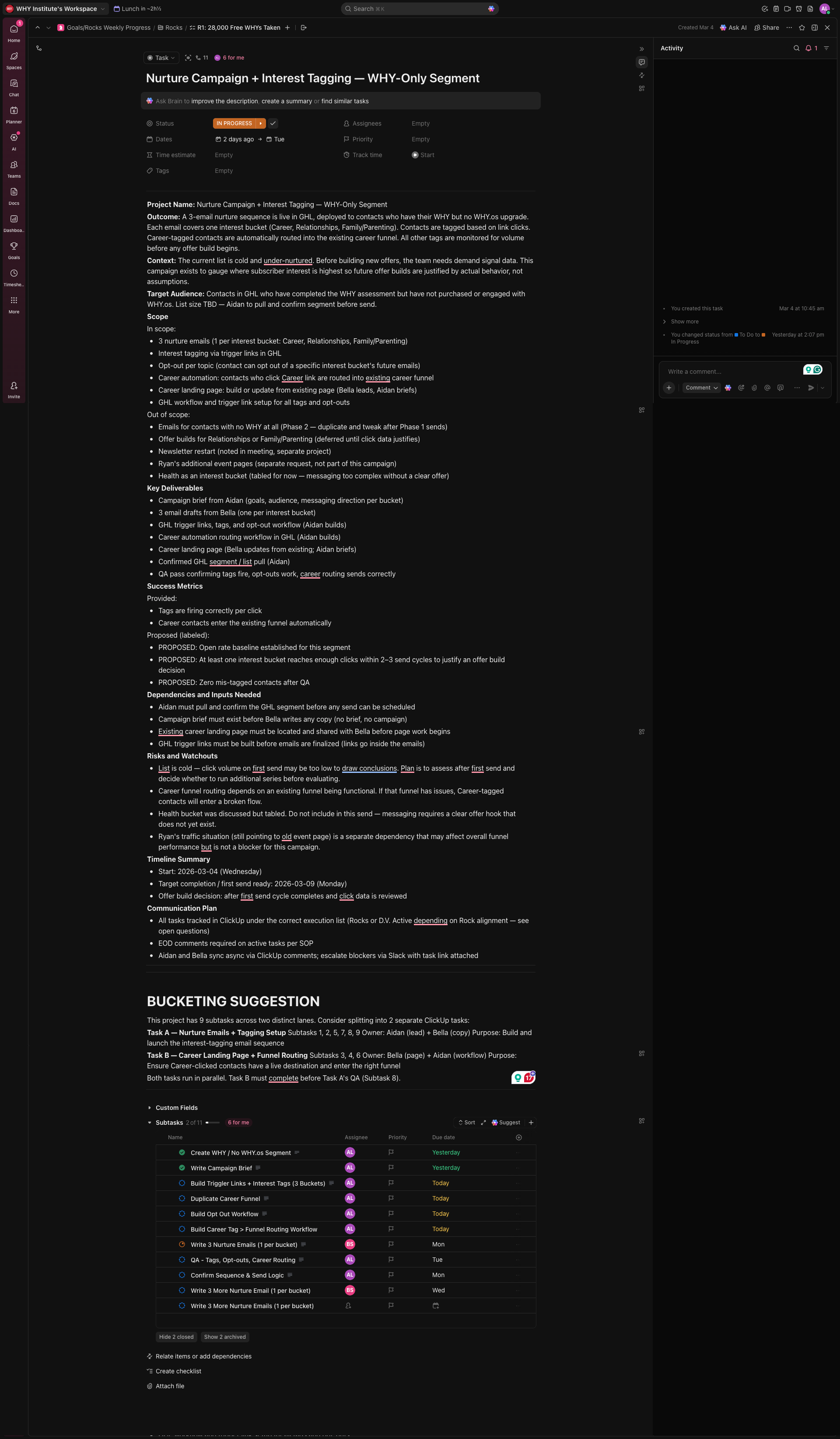
ClickUp project board — 11 subtasks across 2 parallel workstreams with mapped dependencies
First behavioral data this list has ever generated.
- 11,275 previously unmonitored contacts addressed with a coordinated, strategic campaign for the first time
- 6 trigger links + automated tag logic built — Career, Relationships, Family/Parenting interest tags + 3 opt-out suppressors
- Automated funnel routing: Career tag → existing career funnel workflow enrollment, zero manual steps
- First-ever behavioral segmentation data for this audience, replacing ad hoc sends with signal-driven decisions
- ClickUp project delivered: 11 subtasks, 2 parallel workstreams, 6-day start-to-first-send timeline maintained
- Phase 2 ready: sequence built to duplicate for contacts with no WHY Assessment at all
Offer development decisions now driven by signal, not assumption.