Four years of business logic lived in one platform.
Our entire marketing operation lived inside HubSpot. Four years of contact data, behavioral tracking, custom fields, email templates, automation workflows, attribution logic — all of it woven into a platform that had quietly become the nervous system of the business.
The decision came down to switch to GoHighLevel. I resisted it. Not because I was wrong to — the risk was real. A migration of this scale, done carelessly, could mean lost data, broken automations, compliance failures, and a complete collapse of our attribution tracking right before a major course launch. A migration of this scale, done carelessly, could mean lost data, broken automations, compliance failures, and a complete collapse of our attribution tracking right before a major course launch — and we both knew it.
But the decision was made. And when it was, I got to work.
- Contact Records 40,247
- Automation Workflows 20+
- Email Templates 30+
- Custom Fields & Tags 60+
- Funnel Experiences 10+
- Contact Records 40,247
- Automation Workflows 20+
- Email Templates 30+
- Custom Fields & Tags 60+
- Funnel Experiences 10+
Before I touched a single record, I audited everything.
I did an exhaustive audit of everything we had in HubSpot — every automation, every custom field, every template, every data structure, every integration. I documented all of it so that if anything went sideways, we had a clean fallback.
Then I mapped the migration into four phases:
-
01Organize & DocumentFull audit of HubSpot architecture, contact data export, field mapping, compliance review — everything catalogued before anything moved.
-
02CreationRebuilding workflows, email sequences, and templates in GoHighLevel from scratch — not importing, rebuilding with intent.
-
03QATesting every automation against real behavior before any go-live. No shortcuts, no assumptions.
-
04OptimizationPost-migration cleanup, gap identification, and performance tuning once everything was live.
I coordinated a cross-functional team of five — delegating specific tasks by skill set while personally owning the most complex pieces: workflow rebuilds, segmentation logic, compliance setup, SMS workflows, and GA tracking migration. Mid-migration, we hit a real technical problem: GHL was locking workflows when the same contact enrolled more than 50 times in 30 minutes — a loop flag their system triggers automatically. We diagnosed it, worked directly with GHL's technical team to resolve it, and kept the timeline intact.
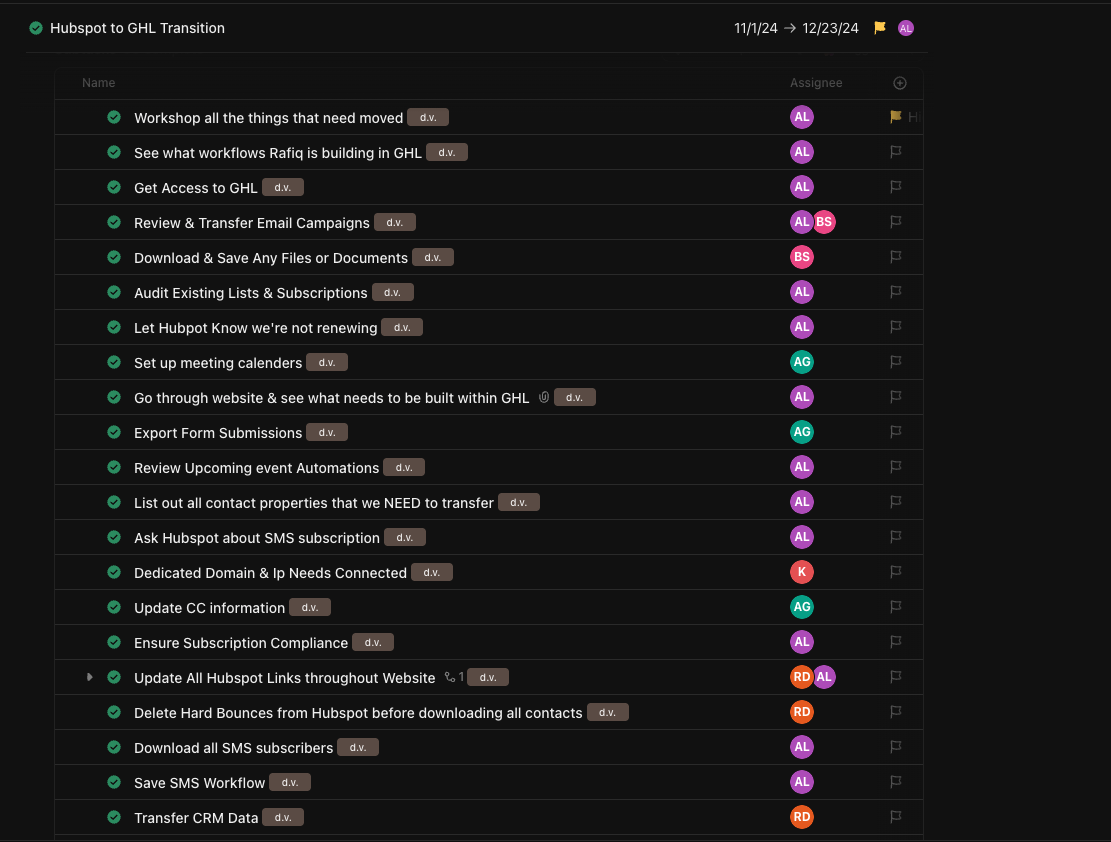
ClickUp project board tracking all 36 migration tasks across four phases — every task closed before the December 23rd deadline.
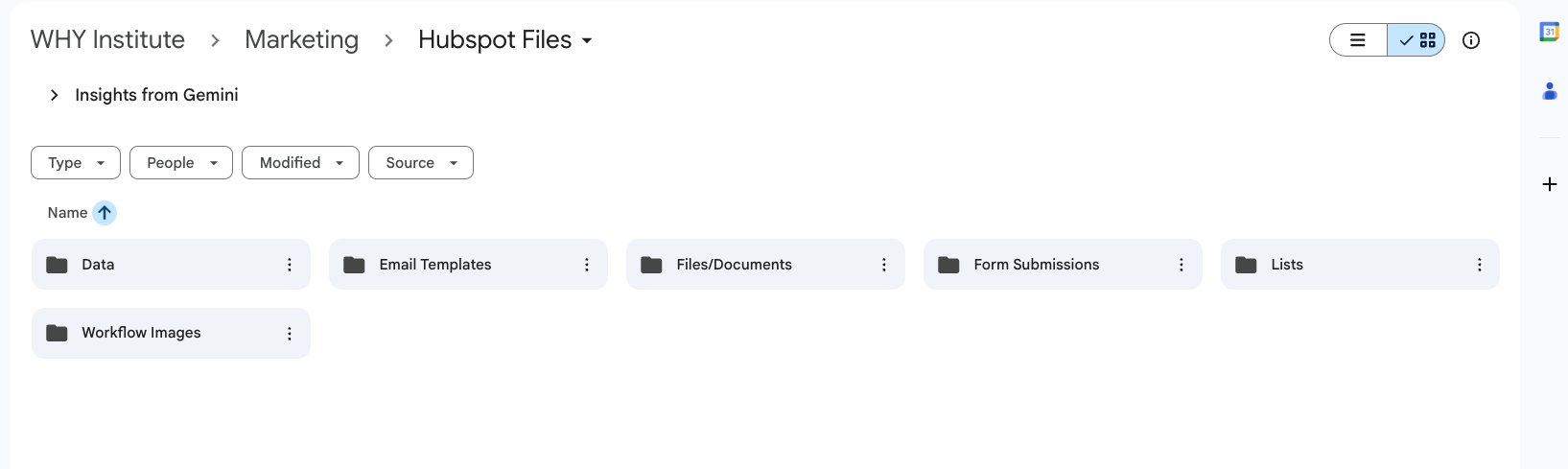
Google Drive archive of all HubSpot assets — templates, workflows, and contact exports — created before any data moved.
I surfaced it early so leadership could make informed decisions rather than discovering it after the fact. That's the job.
52 days. Hard deadline. Nothing on fire.
We got it approximately 90% right on the first pass — which, for a migration of this complexity on this timeline, is the real win. The 10% we're still cleaning up is documented, prioritized, and being resolved systematically.
- Migration completed in 52 days against a hard deadline — HubSpot auto-renewal was December 29th. We finished December 23rd.
- 40,000+ contacts moved securely with zero data loss
- 20+ automated workflows and 10+ funnel experiences rebuilt and re-QA'd
- $12,000+ in annual martech spend eliminated
- Manual list preparation time reduced by 75%
- Compliance, domain setup, and deliverability standards fully established in the new environment
Migration projects fail when they're treated as technical exercises.
This one succeeded because it was treated as a change management project with technical requirements — planned in phases, documented obsessively, communicated clearly, and executed with zero tolerance for ambiguity.
The difference between a migration that works and one that doesn't isn't technical skill. It's project discipline and the willingness to surface problems before they become crises.